Below
is a simply guide to choosing a table tennis table that's appropriate for your
application, and budget.
 1.
Where will you be using the table? 1.
Where will you be using the table?
To have the option of playing outdoors, look for an Outdoor
table tennis table. Outdoor tables normally have the top, bottom and sides encapsulated in aluminium to be more resistant to moisture and warping. Such tables would also have wheels so you can fold the table in two halves to move it easily for storage.
Note the difference between a proper outdoor table and one that's
'weather resistant'... the weather resistant one will only offer
protection from the outdoor condition for a limited time, and are
usually best stored indoors when not in use to extend their lifetime.
Indoor table tend to be significantly cheaper and of
higher performance, so if you're serious about improving your game in
places other than on your outdoor table, you should really an indoor
table.
2. For what purpose will the table be used?
- Beginners and Recreational players - if the table is for a beginner or if you are looking to use the table for fun in your garage or basement, you do not need a professional table built for tournaments. It would be sufficient to purchase a recreational table.
If space is limited, and the table is required solely for recreational reasons, you might want to have a look at the non-standard small tables or
table tennis conversion tops.
- Schools, Game Rooms and Recreational Centers - if the table is meant for use by several players, durability and robustness should be one of the first things to consider. In this case you need to look for a club quality table or a competition table. Refurbished competition tables are also a good option, which are ideal for organizations with a tight budget looking for a top-quality table.
- Tournament Players and Table Tennis Clubs - If you intend to use the table competitively or for professional match training, look for a competition table or for a refurbished competition table. Competition tables offer a thick surface (greater than 3/4") allowing for a very consistent bounce across the entire surface. If you intend to organize competitions ensure the table description says it is ITTF (International Table Tennis Federation) Approved.
3. Do you need to move the table a lot?
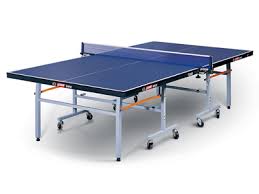
Stationary tables are generally more stable than the rollaway tables on wheels. But unless you are either buying a competition or have ample space to have a stationary table permanently set-up, it is recommended to go for a rollaway table. Naturally, the larger the wheels, the easier it will be to move the table around.
The wheels have locks on them to stop them from moving once put into position.
4. What are the most important features?
Table Surface Thickness is one of the most
important features of the table. Indoor tables are normally 1/2" to 1"
thick. Most competition tables are 1" thick, or slightly less, but
unless you play in tournaments, you will barely notice the difference. A
table thicker than 3/4" will offer a consistent bounce and is usually
good enough for serious players. Outdoor tables are normally thinner and are made of aluminum or resin. This results in a metallic bounce
which is never as good as a competition table, but the material helps durability in outdoor conditions.
Frame Chassis and Legs These features determine the table's stability. Consider the thickness of the table legs, the table frame and the number of connection points in the table chassis to determine the stability and strength of table.
Usually the thicker the legs and structure the better, but don't forget
that this adds a lot to the overall weight, so if you need to move the
table a lot, this may be important!
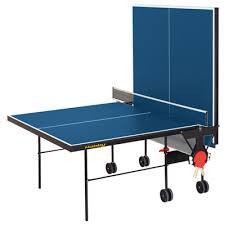 Playback position Playback position
Playback Mode (see photo right) - Tables with this feature allow you to lift one side of the table vertically to practice alone. While this feature is popular with beginners and children, other players will realize that practicing this way is not very effective because the ball will not follow the natural trajectory experienced during a table tennis match, especially when basic spin is applied. Players looking to improve their skills alone would normally purchase a table tennis robot.
Where to buy?
A
few online shops that carry tables are:
Australia:
OOAK Online table tennis store
USA based: Megaspin
|